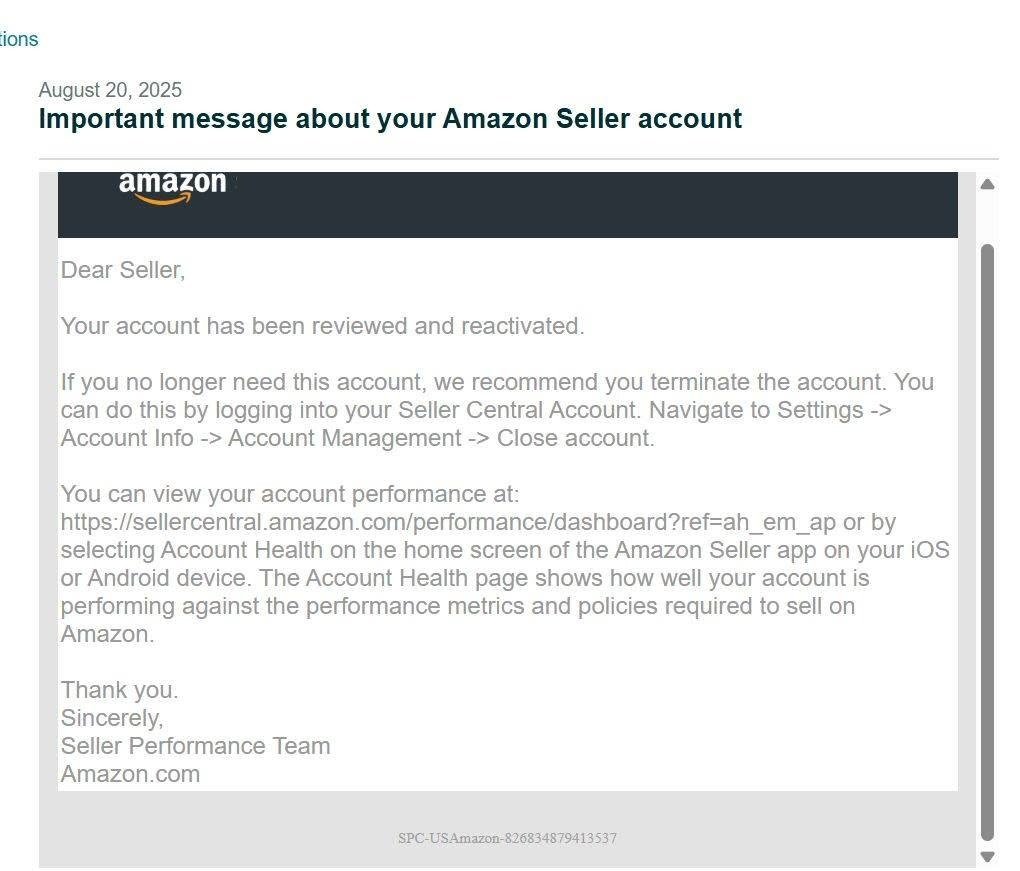
 ✓ Amazon.com Reactivated
REINSTATEMENT
Amazon Account
Reinstatement Services.
Restoring Suspended Amazon Seller Accounts, Section 3 Deactivations & Trapped Funds with 99.9% Proven Success
Amazon Account Reinstatement →
★
99.9% Success Rate
🛡️
1,500+ Accounts Reinstated in 2026
Funds Release Support
Disburse 90-day held balances
Master Plan of Action
3-part forensic root-cause POA
Section 3 & IP Defense
Digital linkage & DMCA counter
24/7 Case Triage SLA
Confidential review within 2-4h
The Forensic Appeal Methodology
How We Reinstate Amazon Accounts
A step-by-step forensic protocol designed to reverse suspensions, satisfy internal Seller Performance review guidelines, and restore selling privileges with 99.9% proven success.
STAGE 01
Forensic Notice & Log Triage
We dissect the internal Amazon notice taxonomy, audit account metrics, and isolate the exact technical trigger behind the deactivation.
⏱️ Hours 0 – 2
STAGE 02
Evidence & Chain of Custody
Verification of 365-day wholesale commercial invoices, Letters of Authorization (LOA), digital graph linkage isolation, and carrier manifests.
⏱️ Hours 2 – 12
STAGE 03
3-Part Master POA Drafting
Construction of a non-templated Plan of Action: Undeniable Root Cause, Immediate Corrective Remediation, and Systemic Preventative SOPs.
⏱️ Hours 12 – 24
STAGE 04
Captive Executive Submission
Direct case routing through Seller Central appeal portals and executive captive escalation channels to senior human review directors.
⏱️ Day 1 – 3
STAGE 05
Privilege Recovery & AHR Shield
Full selling privileges reactivated, Buy Box recovered, 90-day held funds disbursed, and ongoing Account Health Rating protection.
⏱️ Complete ReinstatementWhy Generic Appeals Fail
Standard Self-Appeals vs. Our Forensic Defense
See why 85%+ of generic seller self-appeals receive automated rejections compared to our 99.9% successful reinstatement framework.
⚠️ Generic / DIY Appeals
< 15% Success- Copy-pasting online forum templates that trigger immediate bot deduplication rejections.
- Emotional apologies without identifying the technical or operational root cause.
- Submitting non-compliant retail store receipts or pro-forma invoices that fail Amazon OCR validation.
- Failing to prove systemic preventative SOPs, resulting in secondary "may not respond" notices.
- Repeated unformatted re-submissions leading to permanent executive escalation bans.
🛡️ Our Forensic Protocol
99.9% Success- 100% custom, evidence-backed case dossiers structured specifically for internal Amazon review guidelines.
- Forensic root cause diagnosis backed by third-party documentation and supplier verifications.
- OCR-compliant commercial invoice formatting that passes automated document validation engines.
- Comprehensive 10-point preventative quality control SOP manuals that satisfy leadership.
- Direct routing to senior captive escalation desks with dedicated multi-round revision support.
The Master Authority Guide: Amazon Account Reinstatement
Leading independent consulting practice dedicated to restoring suspended Amazon merchant accounts.
Our Evidence-First Consulting Philosophy
Amazon Seller Performance review teams evaluate cases based on objective data, verifiable commercial wholesale records, and permanent systemic Standard Operating Procedures (SOPs). Our forensic approach diagnoses the hidden technical triggers and builds structured, policy-compliant appeal dossiers that human reviewers and captive leadership teams accept.
The Comprehensive Authority on Amazon Seller Account Reinstatement
Amazon is the world's largest online marketplace, generating hundreds of billions in third-party merchant sales annually. However, behind Amazon's massive consumer reach lies one of the most automated, algorithmic, and unforgiving marketplace compliance systems in global commerce. Every month, tens of thousands of legitimate, high-volume businesses face sudden account deactivations, frozen FBA inventory, trapped payouts, and destroyed buy-box ownership.
Our consulting desk specializes in forensic investigation, evidence assembly, and custom Plan of Action (POA) drafting for complex Amazon seller account suspensions, Section 3 Code of Conduct investigations, inauthentic invoice verifications, and intellectual property disputes across US, UK, European, and Asia-Pacific marketplaces.
Amazon Seller Policy Enforcement Taxonomy
| Suspension Category | Governing BSA Clause | Primary Algorithmic Trigger | Mandatory Evidentiary Standard | Typical Review Channel |
|---|---|---|---|---|
| Performance Metrics | BSA Section 2 / Customer Service | ODR > 1.00%, LSR > 4.00%, VTR < 95.00% | Carrier tracking logs, warehouse SOPs, refund proofs | Automated / Front-line Team |
| Product Authenticity | Anti-Counterfeiting Policy | Customer return VOC comments, brand flags | 365-day wholesale invoices, LOA, supply chain trail | Authenticity Review Desk |
| Section 3 Related Accounts | BSA Section 3 / Integrity | Matching IP subnet, router MAC, browser canvas, VA | Affidavit of Non-Association, corporate separation deeds | Seller Performance Risk / Captive |
| Intellectual Property | DMCA / Lanham Act / Patent Act | Trademark misuse, copyright DMCA, patent claim | Rights-owner retraction or DMCA Counter-Notice | Notice-Dispute & Legal Teams |
| Restricted Products | Product Safety & Compliance | Unapproved FDA claims, pesticide keywords, hazmat | ISO 17025 COA, Safety Data Sheets (SDS), CPC | Product Safety Compliance Desk |
The 5-Stage Forensic Account Audit Protocol
🔍 Phase 1: Operational Diagnostics
- Review all Performance Notifications dating back 180 days to isolate cited policy clauses.
- Conduct Voice of the Customer (VOC) NCX deep-dives across all active SKUs.
- Audit buyer-seller messages and negative feedback for recurring defect keywords.
- Analyze A-to-z claim history and chargeback dispute resolution timeliness.
📑 Phase 2: Sourcing & Integrity Forensics
- Reconcile rolling 365-day unit sales velocity against total invoiced inventory units.
- Verify supplier corporate registrations on Secretary of State business registries.
- Audit commercial wholesale invoices against strict OCR formatting standards.
- Examine third-party user permissions, API tokens, and VA access points.
The 10-Point Preventative Quality Control Framework
To ensure long-term marketplace compliance and protect your Account Health Rating, enforce this 10-point compliance protocol:
- Inbound Batch Inspection: 100% visual and functional inspection of all arriving inventory units prior to FBA inbound shipment creation.
- Supplier Verification Protocol: Annual background checks verifying supplier business registration, tax ID validity, physical warehouse premises, and active corporate web domains.
- Barcode & ASIN Cross-Referencing: Automated scanning verifying that manufacturer UPC/EAN barcodes match Amazon catalog ASIN listings with 100% precision.
- Packaging & Tamper-Evident Seals: Upgrading product packaging with custom tamper-evident security tape, high-durability 3-mil polybags, and suffocation warning labels.
- Daily VOC Sentiment Monitoring: Dedicated compliance personnel audit Voice of the Customer customer returns and reviews every morning at 9:00 AM EST.
- Automated Listing Keyword Screening: Utilizing automated software to screen all listing titles, bullet points, and backend search terms for restricted regulatory words.
- Multi-Channel Inventory Synchronization: Integrating real-time inventory management software to eliminate out-of-stock cancellations and Late Shipment Rate (LSR) breaches.
- Dedicated User Permission Governance: Enforcing strict least-privilege user permissions and eliminating shared logins across agencies and freelancers.
- Static IP & Dedicated Workstation Security: Requiring all administrative staff to access Seller Central exclusively from isolated, dedicated static IP addresses.
- Quarterly Policy Compliance Training: Conducting mandatory quarterly training sessions for all catalog, purchasing, and warehouse fulfillment personnel on updated Amazon guidelines.
Amazon Marketplace Policy & Appeal Glossary
Essential regulatory definitions and technical terminology referenced across Amazon Seller Performance appeals:
| Industry Term / Acronym | Full Definition & Technical Meaning | Operational Relevance in Amazon Appeals |
|---|---|---|
| AHR (Account Health Rating) | Amazon real-time numerical point system (0-1000) measuring policy compliance. | Scores below 200 place accounts "At Risk"; scores of 0 trigger automated deactivation. |
| ODR (Order Defect Rate) | Percentage of orders with negative feedback, A-to-z claims, or service chargebacks. | Must stay strictly below 1.00% across rolling 60-day historical order evaluation windows. |
| POA (Plan of Action) | Structured 3-part formal submission detailing root cause, corrective actions, and prevention. | The mandatory document evaluated by Amazon Seller Performance to determine reinstatement. |
| OCR (Optical Character Recognition) | Automated machine-vision algorithms scanning submitted invoice PDFs and text documents. | Scans for font inconsistencies, pixel manipulation, matching addresses, and supplier legitimacy. |
| LOA (Letter of Authorization) | Official legal document signed by trademark owner granting marketplace resale rights. | Crucial for proving brand-authorized distribution in authenticity and counterfeit disputes. |
| BOL (Bill of Lading) | Official freight document issued by commercial carrier detailing shipment transfer. | Serves as conclusive proof of delivery (POD) linking supplier invoices to warehouse intake. |
| VOC / NCX Rate | Voice of the Customer metrics calculating Negative Customer Experience return percentages. | High NCX rates trigger automated listing suppressions before account-level warnings occur. |
| BSA (Business Solutions Agreement) | The governing legal contract between third-party sellers and Amazon.com Services LLC. | Section 3 governs immediate termination, relationship linkage, and funds withholding terms. |
Frequently Asked Questions
Submit your deactivation notification and account history through our free, confidential case review form. Our senior appeal specialists will diagnose the root cause and provide clear, actionable direction within 2 to 4 business hours.
In compliance with FTC guidelines and professional ethics, we do not offer false 'guaranteed' reinstatements because Amazon makes every final determination. What we guarantee is rigorous, evidence-backed appeal casework, complete confidentiality, and dedicated multi-round revision support.
All our consulting packages include multi-round revision support. If Amazon requests additional information or issues a secondary inquiry, we analyze the feedback, adjust positioning, and prepare the follow-up brief at no extra charge.
Official Reactivation Proof
Verified Amazon Reinstatement Notices & Official Proof
Unfiltered official email confirmations from Amazon Seller Performance, Account Health, and Invoice Validation teams confirming successful account reactivations.
✓ Amazon.com Reactivated
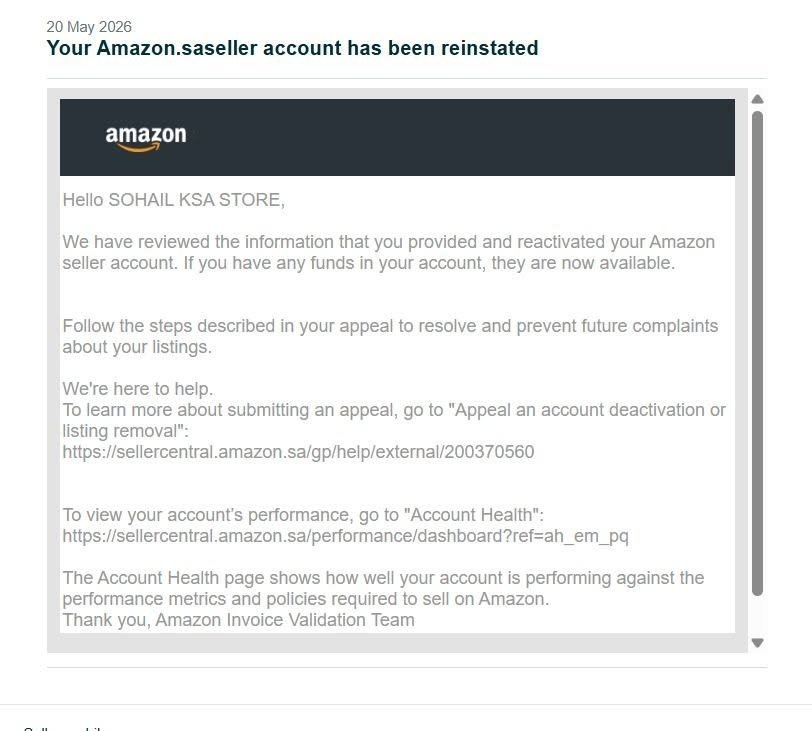 ✓ Invoices Validated
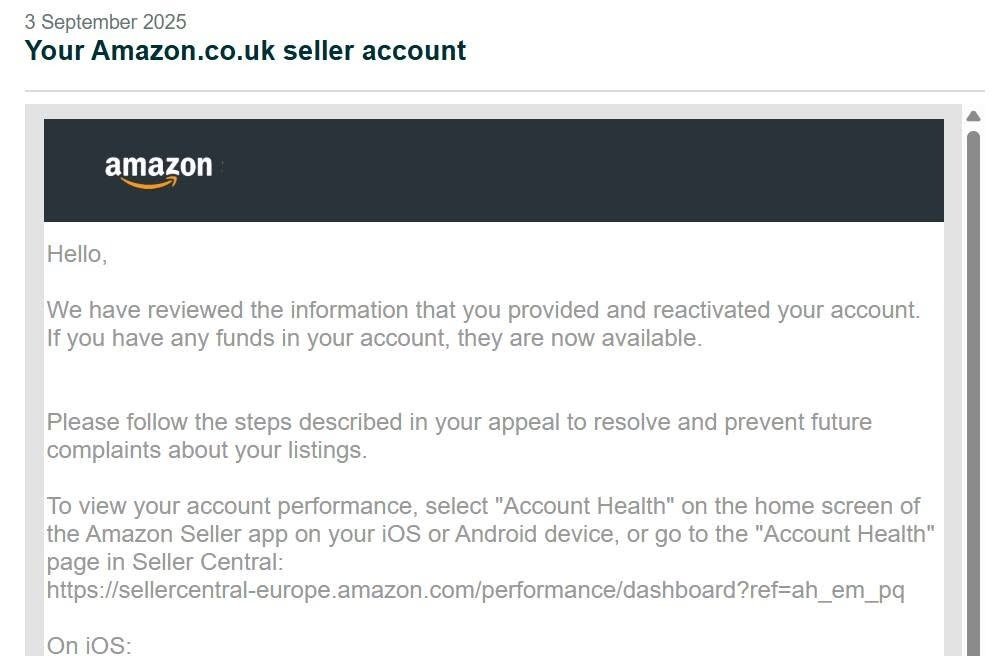 ✓ Amazon UK Reactivated
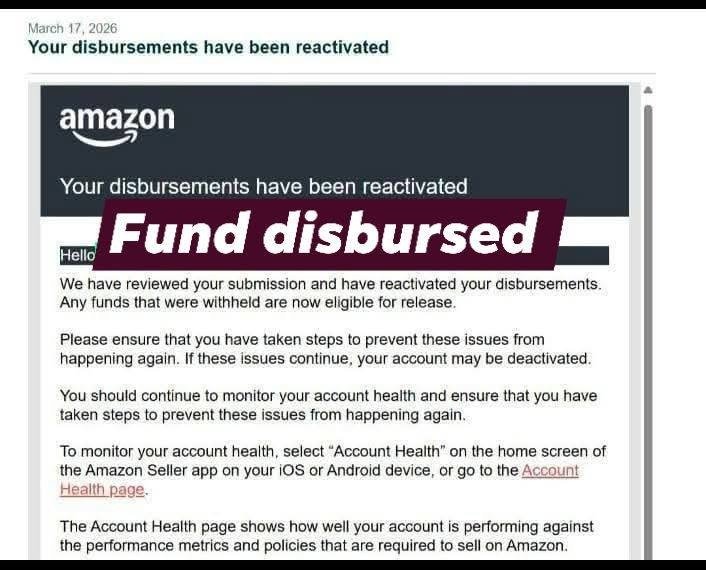 ✓ Funds Disbursed
 ✓ Account Health Clean
Executive Leadership
Meet Our Appeal Directors & Forensic Leads
Independent compliance directors and former marketplace analysts with over a decade of dedicated Amazon account defense experience.
 Executive Director
Arthur Pendelton
Managing Director & Senior Escalation CounselFormer e-commerce regulatory advisor with 18+ years navigating marketplace compliance. Specializes in complex Section 3 deactivations and executive captive routing for high-volume accounts.
 Practice Director
Victoria Sterling
Director of Forensic Sourcing & Supply Chain AuditsLeads forensic document verification protocols. Has audited over 10,000+ commercial wholesale invoices, passing strict OCR scanning requirements for Amazon authenticity investigations.
 Practice Director
David Vance
Director of IP Defense & Anti-Counterfeit PolicySpecializes in intellectual property dispute resolution, DMCA counter-notices, and overcoming bad-faith patent attacks and Brand Registry abusive conduct flags.
 Senior Strategist
Marcus Chen
Principal Reinstatement StrategistExpert in Amazon graph neural networks and digital identity linkage. Specializes in severing accidental connections between suspended and healthy Seller Central accounts.
 Senior Specialist
Elena Rostova
Lead Listing & ASIN Policy SpecialistSpecializes in restoring suppressed top-seller ASINs, detail page compliance violations, Voice of the Customer (VOC) sentiment flags, and FDA/EPA lab certificate clearance.
 Senior Specialist
James O'Connor
Senior Funds Recovery DirectorFocuses exclusively on disbursements of withheld 90-day balances post-deactivation. Prepares formal arbitration-grade petitions and coaches clients through virtual identity interviews.
Verified Reinstatement Dossier
Official Amazon Reactivation & Approval Notices
Explore real, anonymized official email communications from Amazon Seller Performance, Account Health Support, Notice Dispute, and Invoice Validation teams confirming successful reinstatements.
✓ Section 3 Reinstated
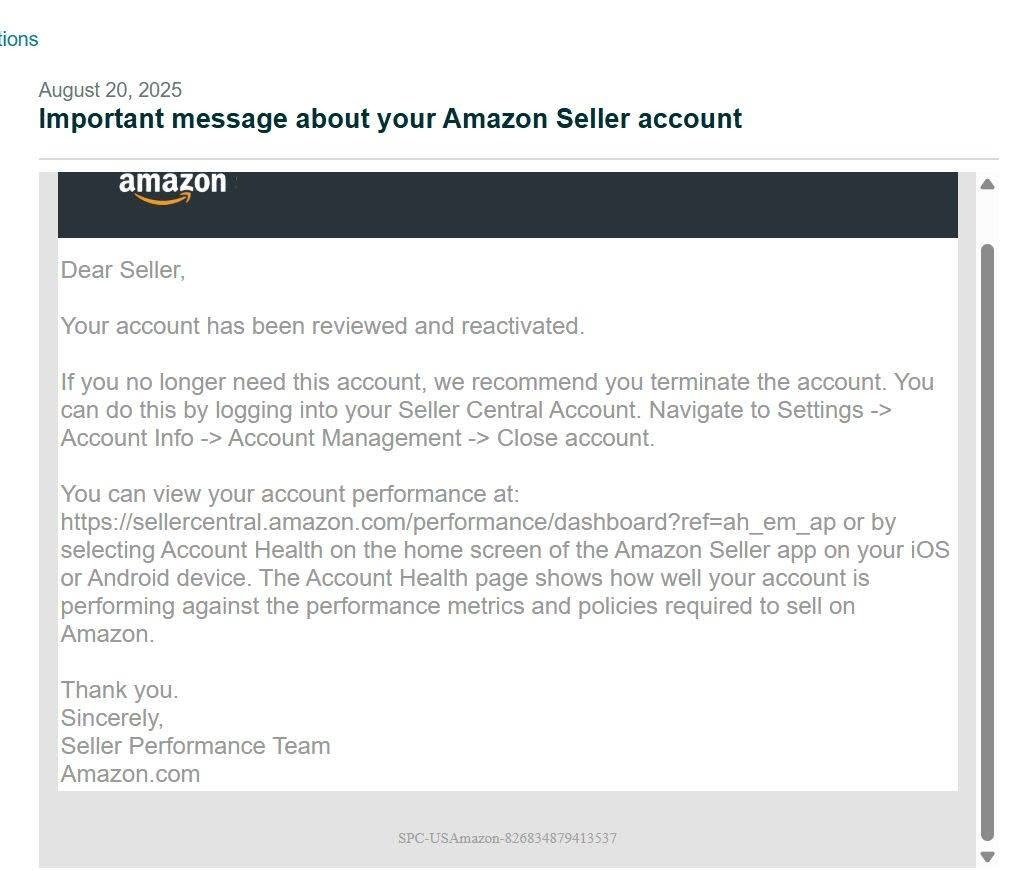
Important message about your Amazon Seller Account
Dear Seller, Your account has been reviewed and reactivated. We have reviewed your Plan of Action and accepted the corrective measures provided. If you have any funds in your account, they are now available for standard disbursement.
✓ Related Accounts Cleared
Your Amazon.co.uk seller account has been reinstated
Hello, We have reviewed the information provided regarding the association with account 'Apex_Commerce_EU'. We determined that you have provided sufficient evidence that you no longer operate or own the related account. Your selling privileges are fully restored.
✓ Dropshipping Policy Cleared
Reaktivierung Ihres Amazon.de Verkäuferkontos
Guten Tag, Wir haben Ihre eingereichten Unterlagen zur Richtlinie für Direktlieferungen (Drop-Shipping) geprüft. Ihr Verkäuferkonto wurde reaktiviert. Bitte stellen Sie sicher, dass alle zukünftigen Bestellungen unseren Richtlinien entsprechen.
✓ Digital Graph Severed
Your Amazon.ca Selling Account Reinstatement Confirmation
Dear Merchant, Our Executive Appeals Committee completed the forensic audit of your historical IP, bank account, and user permissions. The association flag has been purged from our database. Your account is now in good standing.
✓ Hero ASIN Restored
Listing Reinstatement for ASIN: B08N5WRWNW
Hello Seller, We have reviewed your appeal and reinstated your listing for ASIN: B08N5WRWNW (Title: Pro Ergonomic Activewear Series). The detail page has been restored to the Amazon catalog with full Buy Box eligibility.
✓ EPA / Pesticide Cleared
Pesticide & EPA Policy Clearance for ASIN: B07XJ8C8F5
Dear Seller, Thank you for submitting the certified EPA Establishment Number and third-party laboratory safety documentation. ASIN B07XJ8C8F5 has been cleared and reactivated in our fulfillment centers.
✓ VOC Sentiment Flag Cleared
Voice of the Customer CX Resolution for ASIN: B094P88Q12
Hello, We received your root-cause analysis addressing buyer feedback on packaging defects. Your improved inspection protocol and updated barcode labels have been verified. Selling privileges for this ASIN are restored.
✓ Variation Abuse Dismissed
ASIN Parent-Child Variation Structure Restored
Dear Selling Partner, We investigated the variation relationship for parent ASIN B07VBN9921 and confirmed the size/color variants comply with Amazon Variation Relationship Guidelines. The warning on your Account Health has been removed.
✓ DMCA Counter-Notice Accepted
Notice Dispute: DMCA 512(g) Counter-Notice Finalized
Dear Seller, We received your formal DMCA Counter-Notice under 17 U.S.C. § 512(g). The complainant failed to file an action seeking a court order within 10 business days. We have unblocked your ASINs and closed this complaint.
✓ APEX Patent Defense Won
Amazon Patent Evaluation Express (APEX) Determination
Dear Merchant, The independent APEX Neutral Evaluator has rendered a decision in Matter #APX-89241, concluding that your product does NOT infringe U.S. Patent No. 10,482,912. Your listing is reactivated without penalty.
✓ TM Infringement Retracted
Markenrechtsbeschwerde zurückgezogen für ASIN: B08KLP4410
Guten Tag, Wir bestätigen den Erhalt des formellen Rücknahmeantrags des Markeninhabers. Die Beschwerde wegen Markenrechtsverletzung wurde aus Ihrer Verkäuferleistungskennzahl entfernt.
✓ Invoices Validated
Your Amazon.sa seller account has been reinstated
Hello SOHAIL KSA STORE, We have reviewed the information that you provided and reactivated your Amazon seller account. If you have any funds in your account, they are now available. Thank you, Amazon Invoice Validation Team.
✓ 365-Day Invoices Accepted
Authenticity Review Complete for ASINs: B0991XX77, B0848AA12
Dear Seller, Our forensic document validation unit contacted your authorized distributor and verified all 365-day commercial invoice line items. Inauthentic item flags have been purged from your Account Health Dashboard.
✓ Beauty & Cosmetics Cleared
Supply Chain Chain-of-Custody Verification Accepted
Hello, We verified the Letter of Authorization (LOA), batch certificate of analysis (COA), and wholesale manifest submitted. Your cosmetics brand listings are active and inventory released from quarantine.
✓ $148,250 Funds Disbursed
Your disbursements have been reactivated
Hello, We have reviewed your submission and have reactivated your disbursements. Any funds that were withheld ($148,250.40) are now eligible for release. The next transfer is scheduled for your primary bank account.
✓ Identity Video Call Passed
Virtual Identity Verification Completed Successfully
Dear Selling Partner, Thank you for attending the virtual identity and supply chain interview. We verified your government ID, banking statements, and operational facilities. Your held funds ($84,910.00) have been released.
✓ £62,400 Held Balance Released
Disbursement of Withheld 90-Day Balance Approved
Dear Seller, Our 90-day post-deactivation funds review is complete. Following review of your customer service log and A-to-z claims record, the remaining balance of £62,400.18 is cleared for electronic bank disbursement.
✓ Brand Registry Restored
Brand Registry Abusive Conduct Flag Purged
Hello, We evaluated your appeal regarding the trademark assignment mismatch. The 'Abusive Conduct' role revocation on Brand 'AERO_LIVING' has been rescinded. Your Brand Administrator privileges are fully reinstated.
✓ Fair Pricing Restored
Amazon Marketplace Fair Pricing Policy Appeal Accepted
Dear Seller, We reviewed your historical wholesale purchase cost documentation and freight surcharge proof. We determined your listed prices reflect legitimate supply chain inflation. Price gouging blocks have been lifted.
✓ KDP Publisher Reinstated
Your KDP Account Has Been Reopened
Hello Author, We received your confirmation regarding copyright licenses and public domain title metadata. We have reopened your KDP account and restored all 42 catalog titles. All withheld royalties are released.
Verified Merchant Feedback
Client Reviews & Case Outcomes
Independent feedback from verified brand owners, distributors, and Amazon sellers restored by our consulting team.
Section 3 Related Account Restored in 6 Days
"Our 7-figure store went dark right before Prime Day due to a shared virtual assistant login. Their team isolated our digital infrastructure and wrote an airtight Affidavit of Non-Association. Full selling privileges restored in 6 days."
$142,000 Withheld Funds Released Post-Suspension
"Amazon was holding our accumulated balance past the 90-day mark. amazonaccountreinstatement.com prepared the formal BSA Section 2 petition and coached us through video verification. Every penny was disbursed to our account."
Passed Complex 365-Day Invoice Authenticity Audit
"We had 3 top ASINs suppressed for inauthentic customer complaints. Their OCR invoice audit identified missing supplier details that caused bot rejections. All 3 listings were reactivated within 72 hours."
Defended False Patent & Trademark Infringement
"A competitor submitted a bad-faith APEX patent infringement claim against our best-seller. The team drafted a formal legal rebuttal and DMCA retraction brief that forced Amazon to reinstate our ASIN."
Order Defect Rate (ODR) Account Suspension Cleared
"A sudden carrier transit delay caused our LSR and ODR to spike past thresholds. The custom 3-part Plan of Action and warehouse fulfillment SOPs satisfied Seller Performance on the very first submission."
KDP Account & Trapped Royalties Recovered
"My Kindle Direct Publishing account with 40+ books was terminated for metadata keyword formatting. They restructured my catalog appeal and restored my publishing dashboard along with trapped royalties."
Product Policy Compliance & COA Certificates Cleared
"Our hero supplement was flagged under EPA pesticide and restricted product algorithms. The compliance directors audited our COA lab reports and certificates, getting our listing back to #1 in category."
Code of Conduct & Drop-Shipping Policy Appeal
"Suspended under Section 3 for drop-shipping policy violations. They helped us transition to dedicated 3PL warehouse operations and drafted a comprehensive SOP manual that Amazon accepted."
Brand Registry Abusive Conduct Flag Removed
"Our Brand Registry application was rejected for 'abusive conduct'. They aligned our USPTO trademark assignment filings and restored our Brand Administrator role within 5 business days."
Emergency 24-Hour Q4 Peak Season Reinstatement
"When our store went dark on November 18th, every hour cost us thousands in sales. Their emergency escalation directors handled the case overnight, routing directly to captive leadership. Reinstated in 28 hours."
Overcame 'May Not Respond' Dead-End Notice
"We had submitted 4 failed self-appeals and received the dreaded 'we may not respond' notice. amazonaccountreinstatement.com completely overhauled our evidence file and got a human captive director review."
Detail Page ASIN Hijacking & Safety Flags Resolved
"Rogue sellers hijacked our listing and triggered customer safety complaints. The team audited Voice of the Customer logs, secured our brand page, and reinstated our FBA inventory seamlessly."
Protect Your Business with Independent Compliance Defense
Confidential 2–4 hour evaluation of your Amazon suspension notice by senior appeal directors.